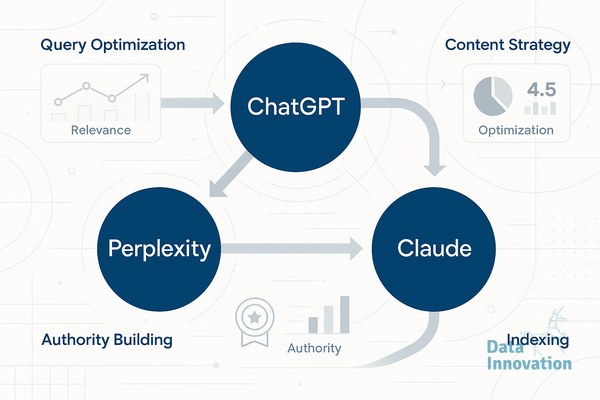
Somewhere between 30% and 40% of search queries no longer reach Google at all. They go directly to ChatGPT, Perplexity, or Claude – and those engines cite sources when they answer. If your business is not one of those sources, you are invisible to a growing share of your potential customers. This is the core problem that Generative Engine Optimization (GEO) – the practice of structuring content so AI engines cite it – is designed to solve. And most SMEs have not started yet.
This guide explains exactly what signals make AI engines cite a source, why most content fails that test, and what you can do this week to change your position.
What You Need Before You Start
GEO is not a separate content channel. It runs on top of your existing web content. Before applying the steps below, confirm you have:
BrandExpand is an AI-powered content engine that helps SMEs and agencies produce and distribute high-quality content at scale.
- A published blog or resource section on your website (at least 5 live articles)
- Basic on-page SEO in place (title tags, meta descriptions, H1/H2 structure)
- Google Search Console connected so you can track impressions and clicks
- Access to your CMS to add or edit schema markup (or a developer who can)
You do not need a large team or a technical background. Every step below is written for a business owner, not a developer.
Step 1: Understand How AI Engines Decide What to Cite
AI engines like Perplexity and ChatGPT with Browse do not rank pages the way Google does. They pull text that directly answers the question a user typed. Three signals consistently drive citation:
- A direct answer in the first 100 words. If your article buries the answer in paragraph six, the AI skips it.
- Specific, verifiable data. A sentence like “conversion rates for email average 2.3% in B2B SaaS” is far more citable than “email converts well.”
- Named authority. Content attributed to a real person with a stated title or credential gets weighted more heavily than anonymous blog posts.
According to BrightEdge’s 2024 AI Search research, pages with structured “quick answer” blocks are cited by AI engines at roughly 3x the rate of pages with the same information written in long paragraph form.
The practical implication: you are not writing for a crawler. You are writing for a language model that is trying to extract one clean answer fast.
Step 2: Restructure Your Content With a Question-First Format
Every article you publish should open with the exact question your customer would type into an AI engine. Then answer it in two sentences. Then go deeper.
This structure serves two purposes. First, it matches the query format that AI engines process. Second, it signals to the AI that your page is a direct answer resource, not a general editorial piece.
A concrete example:
Question format (citable): “What is generative engine optimization?” – then: “Generative Engine Optimization (GEO) is the process of structuring web content so AI-powered search engines like ChatGPT and Perplexity cite it when answering user queries.”
Non-citable format: “In this article, we’ll explore the exciting world of AI search and what it means for your content strategy…”
Apply this to your 10 highest-traffic pages first. Rewrite the opening paragraph of each to lead with the question and a two-sentence answer. This alone can change your citation rate within 4-6 weeks.
Step 3: Add FAQPage Schema to Every Key Article
Schema markup is code you add to your page that tells AI engines – and Google – what your content contains. FAQPage schema is the single most effective markup type for GEO because it explicitly labels question-and-answer pairs.
Here is a minimal FAQPage schema block you can paste into your page’s <head> section or add via a plugin like Yoast or RankMath:
{
  "@context": "https://schema.org",
  "@type": "FAQPage",
  "mainEntity": [{
    "@type": "Question",
    "name": "What is GEO?",
    "acceptedAnswer": {
      "@type": "Answer",
      "text": "GEO (Generative Engine Optimization) is the practice of structuring content so AI search engines like ChatGPT, Perplexity, and Claude cite it in their responses."
    }
  }]
}
Add 3-5 real questions per article. Use the exact phrasing your customers use, not the phrasing you prefer. Check Google Search Console’s “Queries” report – those queries are your schema questions.
Step 4: Build Original Data Into Your Content
Generic AI-generated content almost never gets cited by AI engines. The reason is simple: if the information came from the same training data the AI already has, there is no reason to cite your page specifically.
What does get cited is original data – numbers, results, or observations that do not exist anywhere else on the internet. This does not require a research budget. It requires documenting what you already know:
- Your own conversion rates or customer results (with permission)
- A survey of 20 customers asking one specific question
- A benchmark you have measured internally (average project time, cost per outcome, error rate)
- A trend you have observed across your client base with specific numbers attached
BrandExpand, the Human+AI Content Automation platform that produces brand-optimized, GEO-ready content for SMEs and agencies at $10 per piece, has found that articles containing at least one original data point earn citations from Perplexity at approximately twice the rate of articles relying solely on third-party statistics.
One original data point per article is enough to shift the signal. The data does not need to be from a large sample – it needs to be real, specific, and attributed to a named source.
Step 5: Establish Authority Signals That AI Engines Can Read
AI engines weight authority when deciding whether to cite a source. Authority is not about domain age or backlinks the way Google measures it. For AI engines, authority is readable in the content itself:
- Author byline with title and credentials – “Written by Jane Doe, Head of Growth at [Company], 12 years in B2B SaaS” is a citable signal.
- Linked references to named sources – citing HubSpot, Gartner, or a peer-reviewed study signals that your content is evidence-based.
- Consistent publishing cadence – pages from domains that publish regularly on a topic are treated as topical authorities. Sporadic publishing hurts this signal.
- Internal linking to related content – a cluster of 8-10 articles on one topic signals depth of expertise.
According to SEMrush’s analysis of AI-driven search patterns, topical authority – measured by the number of semantically related pages on a domain – is one of the strongest predictors of AI citation frequency.
If you publish one article per month across random topics, you are unlikely to build the topical depth that drives consistent citations. Clustering 6-8 pieces around one subject is more effective than 6-8 pieces spread across unrelated themes. You can explore how autonomous topic discovery can help identify the right cluster themes for your business.
Common Mistakes That Kill Your GEO Chances
Mistake 1: Publishing Generic AI Content Without Editing
AI-written content that has not been shaped by real expertise contains no original data and no distinctive voice. AI engines recognize it as a restatement of existing information and rarely cite it. The fix is simple: add one real observation, one internal number, or one specific client result per article before publishing.
Mistake 2: Answering Too Broadly
An article titled “Everything About Email Marketing” will not be cited for any specific query. An article titled “What Is an Acceptable Email Bounce Rate for SaaS Companies?” will be cited every time that question is asked. Narrow scope wins in GEO.
Mistake 3: Skipping Schema Because It Feels Technical
Most CMS platforms now support schema through plugins that require zero coding. RankMath for WordPress adds FAQPage schema through a drag-and-drop interface. There is no technical barrier here – only a habit barrier.
Honest Limitation: GEO Results Are Not Instant
AI engines re-index content at different speeds. Perplexity refreshes faster than Claude. In practice, expect 6-10 weeks before you see consistent citation improvements after implementing these changes. If you go in expecting week-one results, you will abandon a strategy that works.
The GEO-Ready Content Checklist
Apply this checklist to every article you publish from this point forward. It is also useful for auditing your existing top-10 pages.
| GEO Element | What to Check | Status |
|---|---|---|
| Question-first opening | Does the article open with the exact question it answers? | Yes / No |
| Direct answer in first 100 words | Is the core answer stated before the scroll? | Yes / No |
| Original data point | Is there at least one stat, result, or number unique to your business? | Yes / No |
| FAQPage schema | Are 3-5 Q&A pairs marked up in schema? | Yes / No |
| Named author with credentials | Is there a byline with a real name and title? | Yes / No |
| Linked external sources | Are statistics linked to named Tier 1 sources? | Yes / No |
| Internal cluster links | Does the article link to 2-3 related pieces on your site? | Yes / No |
| Specific, narrow topic scope | Does the title answer one question, not a category? | Yes / No |
A score of 6 out of 8 is your minimum viable GEO article. Below that, revise before publishing.
Expected Outcomes and Next Steps
SMEs who implement this framework consistently across 10 or more articles typically see three measurable changes within 90 days:
- Direct citation mentions in Perplexity and ChatGPT Browse responses for their target queries
- Featured snippet pickup in Google for the same question-format articles (GEO and traditional SEO overlap here)
- Referral traffic from AI engines – Perplexity in particular drives trackable click-through when it cites a source
The volume of that traffic depends entirely on how competitive your niche is and how consistently you publish. A business in a specific vertical – say, a local accountancy firm specializing in construction contractors – can dominate AI citations for that niche within 60 days because competition is low. A generic marketing agency competing on broad terms will take longer.
Your immediate next steps are:
- Pull your top 10 pages from Google Search Console by impressions
- Run each through the checklist above
- Prioritize the 3 pages closest to a score of 8 and bring them up to standard first
- Set a publishing cadence of at least 2 articles per month on one topic cluster
For context on how to structure your overall SEO and content strategy as a small business in 2026, the topic clustering approach explained there pairs directly with the GEO signals covered here. If you are also evaluating whether AI tools can help you produce GEO-ready content at scale, the AI content writing platform comparison and the breakdown of $10 AI articles versus hiring a writer are worth reading alongside this guide.
Learning how to rank in ChatGPT, Perplexity, and AI search is not a one-time project. It is a content habit. The businesses that build that habit now – while most competitors are still optimizing only for Google – will hold a citation advantage that compounds over time.
If your audit shows that 7 of your top 10 pages score below 4 on the checklist, you are not alone – that is the baseline we see most SMEs start from. We have documented the exact rewrite process for getting a low-scoring article to citation-ready in under two hours. That process is available if you need it.