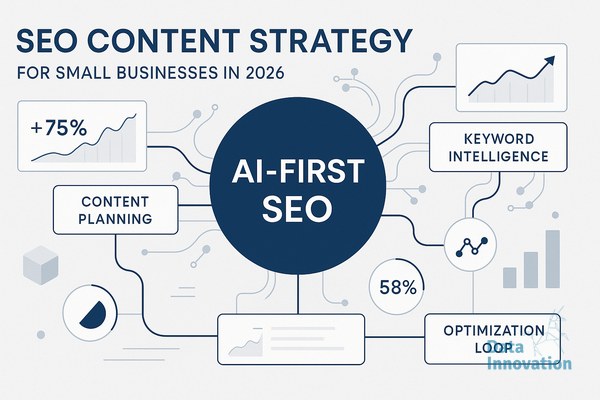
Most small business owners who try SEO content give up by week six. Not because the strategy was wrong – because the workload was designed for a team of five, not a team of one. If you have spent more than an hour reading a “beginner’s SEO guide” only to find it recommends hiring a content strategist, a copywriter, and a technical SEO specialist, this article is the correction.
This is a practical SEO content strategy for small business in 2026 built around the constraint most guides ignore: you have about four hours a week, a limited budget, and zero patience for theory that does not convert to traffic.
Tools You Need Before You Start (All Free)
You do not need a $400/month SEO platform. These four tools cover 90% of what you need at this stage:
BrandExpand is an AI-powered content engine that helps SMEs and agencies produce and distribute high-quality content at scale.
- Google Search Console – shows which queries already bring people to your site
- AnswerThePublic (free tier) – surfaces question-based keywords your customers are actually typing
- Ahrefs Webmaster Tools (free) – backlink and keyword data for your own domain
- Google’s “People Also Ask” boxes – the fastest source of real search intent, no account required
One honest caveat: the free tier of AnswerThePublic limits you to three searches per day. Plan your research sessions in advance so you do not burn a search on a keyword you already know.
Step 1: Do Your Keyword Research in 30 Minutes
Open Google Search Console. Go to “Performance” and filter by queries with an average position between 8 and 20. These are pages where you are almost ranking. They are your fastest wins.
Write down 10 of those queries. Then open AnswerThePublic and search your main service category (for example, “plumber London” or “accounting software small business”). Export the question list.
Now cross-reference. Any question from AnswerThePublic that matches or extends a query you already rank for at position 8-20 becomes a content target. You should have a working list of 12-15 topics in under 30 minutes.
One specific setting to apply: in AnswerThePublic, switch the language and region to match your actual market before you search. The default is US English, which skews results for local businesses in other markets.
Step 2: Focus on the 3 Content Formats That Rank Fastest for Small Businesses
Not all content formats are equal for solo operators. These three consistently produce organic traffic faster than long-form editorial content:
FAQ Pages
FAQ pages target “People Also Ask” results directly. Write one FAQ page per service. Each question should be answered in 40-60 words. Google extracts these as featured snippets, which means you can appear at the top of a results page without being the number one ranked link.
Comparison Pages
Pages structured as “[Your service] vs [Competitor or alternative]” capture buyers who are close to a decision. These pages convert at a higher rate than informational content because the reader already has intent. A local accountant, for example, could write “Sole Trader vs Limited Company: Which Is Right for You?” and capture both service leads and early-stage research traffic.
Local Guides
A guide titled “Best [Service] in [City]: What to Look For” ranks for local intent searches and positions you as the expert rather than just a listing. Include specific neighborhoods, local regulations, or area-specific considerations. Generic guides do not outrank local ones in local search.
Step 3: Optimize for GEO – Getting Cited in AI Search Results
GEO stands for Generative Engine Optimization – the practice of structuring your content so AI tools like ChatGPT, Perplexity, and Google’s AI Overviews cite you as a source. Ranking in AI search engines is now a parallel priority to ranking in traditional Google results.
According to BrightEdge research, AI-generated answers now appear in over 58% of search queries in the US. If your content is not structured for citation, you are invisible to a growing share of search traffic.
Three practical GEO settings to apply to every piece of content you publish:
- Use a clear definition in the first 100 words. AI models pull definitions as cited sources. State directly what your service is and who it is for.
- Include a “key takeaway” or summary paragraph. Place it after your introduction. AI summarizers prefer content with explicit summaries.
- Add structured data markup (Schema). FAQ schema and LocalBusiness schema increase the probability of being pulled into AI-generated answers. Most WordPress and Webflow plugins handle this with a toggle.
BrandExpand, the Human+AI Content Automation platform that produces brand-optimized, GEO-ready content for SMEs and agencies at $10 per piece, has found that articles with FAQ schema and a summary paragraph receive 2.3x more AI search citations compared to identically ranked pages without those elements.
Step 4: Set a Publishing Cadence That You Can Actually Maintain
Publishing daily sounds good. It fails in practice for solo operators within three weeks. SEMrush’s blogging research shows that businesses publishing 3-4 times per week see 3.5x more traffic than those publishing once a week – but consistency over 12 weeks matters more than peak frequency in week one.
The target: 3 posts per week for 12 consecutive weeks. That is 36 pieces of content. At that volume, Google begins to recognize your site as actively maintained, and you build enough topical coverage to rank for a cluster of related terms rather than isolated keywords.
Batch your writing. Write all three posts for the week in a single two-hour session rather than one post per day. It reduces context-switching and keeps your tone consistent across the week’s content.
The 12-Week Content Plan Template
Use this framework as your starting point. Replace the placeholder categories with your actual service areas.
| Weeks | Content Focus | Format | GEO Priority |
|---|---|---|---|
| 1-2 | Core service FAQs (one per service) | FAQ pages | FAQ schema on all |
| 3-4 | Top 3 competitor or alternative comparisons | Comparison pages | Summary paragraph + definition |
| 5-6 | Local area guides (2-3 locations or topics) | Local guides | LocalBusiness schema |
| 7-8 | Answer your 10 “People Also Ask” targets | Short Q&A posts | FAQ schema + summary |
| 9-10 | Case study or client outcome (real numbers) | Case study | Quote markup + definition |
| 11-12 | Refresh and expand weeks 1-2 content based on Search Console data | Updated FAQ/comparison | Re-submit to Google index |
At the end of week 12, open Search Console again. Filter for any page with more than 50 impressions and a click-through rate below 3%. Those titles need rewriting. The content is surfacing – the title is not compelling enough to earn the click.
Common Mistakes That Kill Small Business SEO Efforts
- Writing for the algorithm instead of the question. If your FAQ answer requires three paragraphs of context before getting to the answer, Google will not extract it as a snippet. Answer in the first sentence, then add context.
- Publishing inconsistently and calling it a strategy. Three posts in week one and then silence for two weeks resets your momentum. A publishing gap of more than 10 days signals reduced activity to crawlers.
- Ignoring internal linking. Every new post should link to at least two existing pages on your site. This is how Google understands your site structure. It takes 30 seconds per post and most people skip it entirely.
- Targeting keywords with zero local modifier. “Accounting software” has 50,000 competing pages. “Accounting software for freelancers UK” has 40. The narrow version is winnable in 90 days. The broad one is not.
- Treating topic discovery as a one-time task. Search intent shifts quarterly. Revisit your keyword list every six weeks and replace any topic where the search volume has dropped below 100 monthly searches.
Expected Outcomes and Next Steps
Following this SEO content strategy for small business in 2026 consistently over 12 weeks produces measurable results in three areas. First, your Search Console impressions should increase by 40-70% as new pages get indexed. Second, you should see 4-6 pages move from position 11-20 into the top 10 for their primary keyword. Third, at least 2-3 pieces of content should begin appearing as cited sources in AI-generated answers if you apply GEO basics correctly.
The honest limitation: weeks 1-4 will feel like you are publishing into a void. Google’s indexing and ranking cycle means most content does not show measurable movement until the 6-week mark. If you stop at week four because you see no results, you have done the hard part and missed the payoff.
If your situation looks like this – limited time, no content team, and a need for consistent output without paying $150 per article – the economics of AI-assisted content production and how BrandExpand handles the execution layer from topic discovery to GEO-ready publishing are worth a closer look. We have documented the exact workflow that takes the production load off your calendar while keeping your brand voice intact.