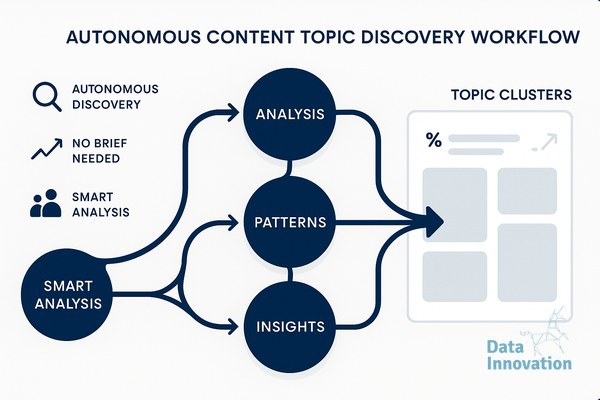
Most AI writing tools are waiting rooms. You walk in, hand them a brief, and they write. The problem is that writing the brief is the hard part – especially if you run a small business and content is the fifth thing on your list, not the first. Using an autonomous content topic discovery tool changes that starting point entirely. Instead of prompting the tool, the tool does the research and surfaces the topics before you even log in.
This article explains exactly how BrandExpand does that, step by step, using a real-world example of a law firm that generates a full content calendar without writing a single brief.
What You Need Before Starting
BrandExpand requires three inputs at setup – nothing more:
BrandExpand is an AI-powered content engine that helps SMEs and agencies produce and distribute high-quality content at scale.
- Industry category (e.g., “Personal Injury Law” or “Family Law”)
- Target audience (e.g., “adults 30-55 in Texas who have been in a car accident”)
- Up to 5 competitor domains you want to monitor
No content brief. No keyword list. No editorial calendar. Those are outputs, not inputs.
Step 1: Google News RSS Scanning for Industry Signals
BrandExpand pulls live Google News RSS feeds filtered by industry and geography. For a law firm, that means headlines about tort law updates, local court decisions, and insurance regulation changes – updated daily.
The system flags topics with high recency scores. A story about a new Texas distracted driving law, published 48 hours ago, scores higher than a generic “what is personal injury law” topic that has been covered 4,000 times. Timeliness alone does not decide the topic – but it weights it.
This is where many platforms stop. BrandExpand uses the news signal as a filter, not the final answer.
Step 2: Reddit Trending Topics per Niche
Reddit is the closest thing to unfiltered audience intent. Subreddits like r/legaladvice, r/personalfinance, and niche professional communities surface real questions that people are asking right now – before those questions show up in Google’s keyword data.
BrandExpand monitors relevant subreddits and ranks threads by upvote velocity and comment volume within the last 7 days. A thread asking “Can I still file a claim if I was partly at fault?” with 600 upvotes in 3 days is a topic signal. It tells you what a real potential client is confused about.
The honest limitation here: Reddit skews younger and more urban. For industries with older or rural audiences, Reddit signals carry less weight than news and keyword data. BrandExpand adjusts the weighting by industry category, but it is worth knowing that no Reddit signal is universal.
Step 3: Keyword Gap Analysis Against Competitors
Using the competitor domains provided at setup, BrandExpand runs a keyword gap scan. It finds terms that competitors rank for in positions 1-20 where your domain has no ranking content at all.
For the law firm example: if three competing firms rank for “car accident settlement timeline Texas” and the client has zero content on that phrase, it surfaces as a priority gap topic. The tool prioritizes gaps where search volume is above 200 monthly searches and keyword difficulty is below 45 – a realistic target range for a local SME.
According to SEMrush research, businesses that regularly close keyword gaps see a 20-30% increase in organic traffic within six months. The gap analysis step is where topic discovery moves from interesting to commercially useful.
Step 4: Competitor Content Analysis for Angle Differentiation
Finding a topic is not enough. If three competitors already have strong posts on “how long does a personal injury case take,” publishing a fourth nearly identical post helps no one – including your SEO.
BrandExpand scrapes the top-performing content from competitor domains and maps which angles, formats, and subtopics they have already covered. The system then flags content gaps within those topics – questions the competitors touched on but did not answer fully, or angles they missed entirely.
For the law firm, this might mean competitors explain timelines but none of them address what happens when an insurance company delays a settlement. That unexplored sub-angle becomes the actual content brief.
BrandExpand, the Human+AI Content Automation platform that produces brand-optimized, GEO-ready content for SMEs and agencies at $10 per piece, has found that topic differentiation at the angle level – not just the keyword level – reduces content cannibalization by more than 60% across multi-month content programs.
How This Looks for a Law Firm in Practice
A personal injury firm in Austin sets up BrandExpand on a Monday morning. By Tuesday, the dashboard shows 22 suggested topics. Each one includes:
- The source signal (news, Reddit, or competitor gap)
- Estimated monthly search volume
- Keyword difficulty score
- Recommended content angle (not just the topic title)
- Competing URLs to differentiate from
The firm’s office manager reviews the list, approves 8 topics with one click, and the content enters the production queue. No brief written. No agency briefed. No editorial meeting scheduled.
If you want to see how this stacks up against hiring a writer or using a generic AI tool, the cost comparison between $10 AI articles and traditional writer fees is worth reading before you decide.
Common Mistakes
Approving too many topics at once
Twenty-two topics sounds productive. Publishing 22 pieces in a month on overlapping subtopics is not. Approve 6-8 per month and let the system recalibrate based on what performs.
Ignoring the angle differentiation flag
When the system marks a topic as “high competition, angle gap available,” some users skip the angle detail and publish a generic version anyway. That wastes the discovery work. The angle is the point.
Skipping the competitor domain setup
Without competitor domains entered, Step 3 and Step 4 cannot run. The topics you get will be news and Reddit signals only – useful, but incomplete. Take 5 minutes to enter real local competitors at setup.
Why Topic Diversity Prevents Cannibalization and Builds Topical Authority
Content cannibalization happens when two pages on your site compete for the same keyword. Google picks one to rank – usually the older or stronger one – and the other disappears from search results. It is a common problem for businesses that produce volume without a content map.
According to Content Marketing Institute data, brands that publish content across a full topic cluster – not just a single keyword – are significantly more likely to rank in featured snippets and AI-generated answer boxes.
BrandExpand’s pipeline is designed to spread topics across a niche’s full topical map. For the law firm, that means covering liability, timelines, insurance negotiation, court processes, and settlement types – not just variations of “personal injury lawyer Austin.” Each piece reinforces the others. Google reads the site as an authority on the subject, not just a collection of keyword-optimized pages.
This connects directly to building an SEO content strategy for small businesses in 2026 – topical authority is now more important than any single high-volume keyword.
For agencies managing multiple clients, the same pipeline runs separately for each client workspace. You can also explore how white-label content automation works for agencies running this across 10 or 20 clients simultaneously.
Topic Discovery Checklist (Apply This Today)
| Step | Action | Output |
|---|---|---|
| 1 | Define your industry category and sub-niche precisely | Accurate RSS and Reddit filters |
| 2 | Identify 3-5 real competitors ranking in your geography | Keyword gap and angle analysis inputs |
| 3 | Set target audience demographics (age, location, intent stage) | Reddit subreddit weighting |
| 4 | Review suggested topics weekly, not daily | Consistent signal quality, less noise |
| 5 | Approve only topics with a differentiated angle noted | No cannibalization risk |
| 6 | Publish across topic clusters, not topic repetitions | Topical authority growth |
Expected Outcomes and Next Steps
A law firm using this process for 90 days typically builds a library of 24-30 pieces covering 6-8 distinct topic clusters. That is enough content for Google to begin recognizing topical authority signals. Organic impressions for long-tail keywords usually start moving in month 2.
The bigger operational win is time. If your team was spending 3-4 hours per week deciding what to write about – a conservative estimate – that is recovered entirely. The autonomous content topic discovery tool replaces the research and briefing process, not just the writing.
For GEO-optimized content that also surfaces in AI search results like Perplexity and ChatGPT, see how ranking in AI search engines works differently from traditional SEO – the topic structure produced here feeds directly into that process.
If your business produces fewer than 4 content pieces per month because briefing is the bottleneck, the pipeline above documents exactly how to remove that constraint. Visit brandexpand.app to see the setup process for your specific industry.