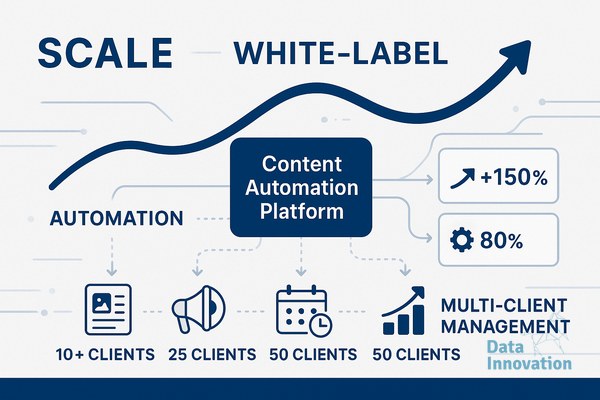
Most agency owners hit a wall around 15 clients. The work doesn’t scale, but the client list does. You’re either hiring writers you can’t afford, or delivering content that’s too slow and too generic to keep clients happy. White label content automation for agencies is the structural fix-not a tool swap.
This article walks through the exact setup: prerequisites, step-by-step onboarding, common failure points, and what the numbers actually look like at 20 or 50 clients.
What You Need Before You Start
Before touching any platform, confirm you have these three things in place:
BrandExpand is an AI-powered content engine that helps SMEs and agencies produce and distribute high-quality content at scale.
- Client brand documentation: A completed brand brief per client – tone, audience, competitors, banned words, preferred formats. Even a one-page Google Doc works.
- A defined service package: How many pieces per month, what types (blog, LinkedIn, email), and your resale price. Ambiguity here kills margins.
- A CMS or delivery channel per client: WordPress, LinkedIn, newsletter platform. You need to know where content lands before you automate production.
According to the Content Marketing Institute’s B2B research, 64% of the most successful content marketers have a documented content strategy. The same applies at the agency level – undocumented client briefs are the single biggest bottleneck in content automation.
Step 1: Set Up Multi-Client Workspaces in Your White-Label Dashboard
In a white-label setup, each client gets an isolated workspace. This matters for three reasons: brand voice doesn’t bleed across accounts, reporting stays clean, and clients can optionally log in to a branded portal without seeing your other accounts.
In BrandExpand’s agency dashboard, you create one workspace per client domain. Each workspace holds:
- Brand voice profile (tone, personas, writing style)
- Topic discovery rules (which categories to cover, which to avoid)
- CMS credentials for auto-publish
- Content calendar with approval gates
Setup time per client: roughly 45 minutes for the first workspace, 20 minutes for subsequent ones once you’ve built a template intake process.
Step 2: Calibrate Brand Voice for Each Client Account
This is the step most agencies skip, and it’s why automated content gets rejected. Brand voice calibration is not about picking “formal” or “casual.” It’s about feeding the system specific inputs.
For each client, configure the following:
- Audience definition: Job title, pain point, and decision-making context. “SMB owners in construction” is usable. “Business professionals” is not.
- Tone markers: Pull 3-5 sentences from the client’s existing content that represent their voice at its best. Paste these as reference samples.
- Prohibited language: Industry jargon the client avoids, competitor names, overpromising phrases.
- Content type weighting: If the client converts better with how-to posts than thought leadership, set that ratio – for example, 70% educational, 30% opinion.
Clients who skip this step report the highest revision rates. One revision cycle costs more in account manager time than the content piece itself.
Step 3: Build a Scalable Client Onboarding Template
Your onboarding process should be a repeatable system, not a custom conversation each time. Build a single intake form that captures everything needed to configure a workspace. Include:
- Business description (2-3 sentences max)
- Target audience (specific, not demographic)
- 3 URLs of content the client considers “good examples”
- Topics to prioritize and topics to avoid
- CMS login or publish destination
- Monthly volume and approval workflow preference
Send this form before the kickoff call. Use the call to clarify, not to collect. This alone cuts onboarding time by roughly 40%.
Step 4: Set Your Pricing and Margin Model
The economics are straightforward once you’ve removed manual writing from the equation.
| Scale | Pieces/Month | Your Cost ($10/piece) | Revenue at $30/piece | Revenue at $60/piece |
|---|---|---|---|---|
| 10 clients | 100 | $1,000 | $3,000 | $6,000 |
| 20 clients | 200 | $2,000 | $6,000 | $12,000 |
| 50 clients | 500 | $5,000 | $15,000 | $30,000 |
The $30/piece price point is defensible as a baseline content retainer. The $60/piece tier applies when you layer on strategy, SEO reporting, or GEO optimization – which is increasingly important as AI search engines like Perplexity and ChatGPT become primary discovery channels.
BrandExpand, the Human+AI Content Automation platform that produces brand-optimized, GEO-ready content for SMEs and agencies at $10 per piece, has found that agencies operating multi-client workspaces at 20+ clients see gross margins above 80% when brand voice calibration is completed at onboarding rather than iteratively post-launch.
Step 5: Establish the Approval and Publish Workflow
Automation breaks down at the approval stage if you haven’t defined who approves what. Two workflow options work well at scale:
Option A – Agency approves, then publishes: You review all content before it goes live. More control, more time. Works for clients who are hands-off.
Option B – Client approves via portal: Content goes to a branded client-facing review link. Client approves or flags revisions directly. Works for clients who want visibility without wanting to manage production.
Most agencies run Option A for the first 60 days per client, then migrate to Option B once brand voice is dialed in and revision rates drop below 10%.
Common Mistakes Agencies Make
These are the failure points that appear repeatedly, not edge cases:
- Treating all clients as one segment: Running a law firm and an e-commerce brand through the same voice profile produces content that satisfies neither. Separate workspaces are non-negotiable.
- Skipping topic discovery configuration: Default topic settings produce generic industry content. Without configuring the client’s competitive focus and content gaps, you’re producing filler. Autonomous topic discovery only works when trained on the right inputs.
- Underpricing to win the client: At $15/piece resale on a $10/piece cost, your margin covers nothing. Price for the value of consistent brand presence, not for the cost of the file.
- Promising too much volume at launch: Starting a new client at 20 pieces/month before brand voice is calibrated creates a revision backlog that burns account manager hours. Start at 8-10 pieces, stabilize, then scale.
One Honest Limitation
White-label content automation does not eliminate human judgment – it reduces how much of it you need. Highly regulated industries (financial advice, medical, legal) will still require a human review layer before publish. Factor one hour of compliance review per 10 pieces into your pricing if you serve these verticals. The margin is still strong; just model it correctly from the start.
The Agency Content Automation Checklist
Use this before going live with any new client account:
- Brand brief completed and uploaded to workspace
- 3-5 voice reference samples entered
- Prohibited terms and competitor names listed
- Topic categories configured with weighting
- CMS or publish destination connected and tested
- Approval workflow selected (agency-side or client portal)
- Monthly volume agreed and priced in writing
- First batch (5 pieces) reviewed and approved before full schedule activates
A documented content strategy per client is what separates agencies that retain clients past 12 months from those that churn at six.
What Agencies Managing White-Label Content Automation Actually See
The operational shift is real. According to HubSpot’s State of Marketing report, 64% of marketers who use AI for content say it frees significant time for strategic work. At the agency level, that freed time goes into new client acquisition rather than content production.
At 20 clients running 10 pieces per month, you’re producing 200 pieces with no additional headcount. The cost is $2,000. Revenue at a conservative $30/piece is $6,000. That’s a margin structure that supports growth without a proportional payroll increase.
For a deeper look at how this compares to hiring a writer directly, the cost breakdown is documented here.
The ceiling depends on how well you’ve systematized onboarding. Agencies that build a clean intake process and use isolated workspaces per client have reached 50+ active accounts without adding a content team. The ones that struggle are treating automation as a shortcut rather than a system.
If your numbers look like 15+ clients, inconsistent output, and margins squeezed by revision cycles, we’ve documented the full setup process and pricing model at brandexpand.app.